SEO 2026: The Ultimate AEO & GEO Implementation Checklist
An Enterprise Reference Guide for Modern Content Architecture
By Efren Tagudan Salvador
Website Architect | SEO · GEO · AEO · Specialist
The New Rules of Algorithmic Visibility
Why Traditional Search Optimization is Failing
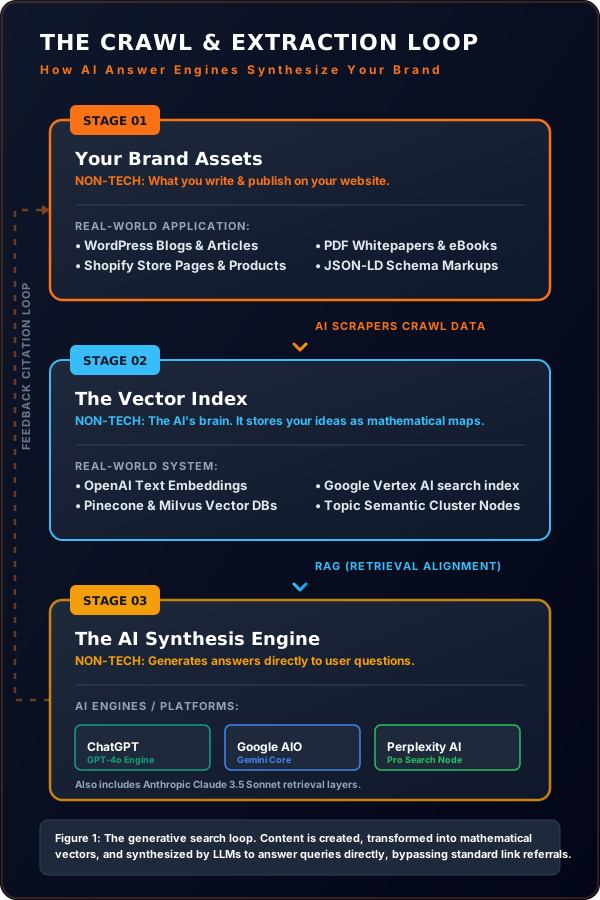
Traditional search engine optimization relies heavily on keyword frequencies and domain backlink profiles to rank static text links. In 2026, discovery behavior is dominated by natural language answer engines like Google AI Overviews, Perplexity, OpenAI Search, and Claude. These systems do not point users to websites; they synthesize multi-source data to answer queries directly. To remain visible, brands must optimize for machine retrieval, model alignment, and explicit vector space relevance.
At the center of this paradigm shift is the transition from lexical indexing structures to high-dimensional vector space embeddings. Unlike traditional database queries that require exact keyword overlap, neural search architectures tokenize document passages and map them into multi-dimensional vectors where semantic similarity is calculated mathematically. Search algorithms analyze the syntactic and semantic topology of content to match the underlying intent of a user's prompt rather than static words. This means lexical fluff and keyphrase repetition are no longer sufficient; domains must present mathematically coherent context to be indexed effectively.
Furthermore, retrieval architectures rely heavily on Retrieval-Augmented Generation (RAG) frameworks to ground language models in real-world facts. When a user submits a query, the model acts not just as a generator, but as a retriever, searching the web for external document chunks to synthesize the final answer. To be selected as a grounding citation, content must be structured in highly extraction-friendly fragments. Brands that fail to format their digital assets to support precise programmatic ingestion will be completely bypassed by LLM scrapers, rendering them invisible in conversational search journeys.
The Core Pillars of Modern Machine Optimization
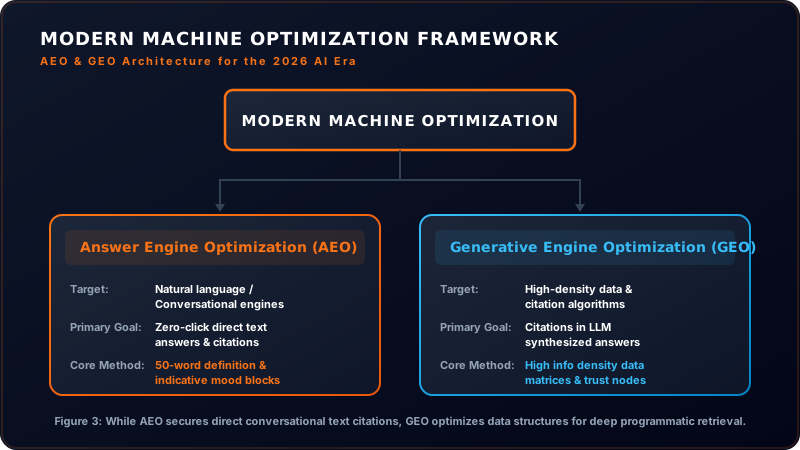
To gain citations within generative AI responses, your data assets must be structurally engineered for machine consumption. This optimization process splits into two distinct operational methodologies: Answer Engine Optimization (AEO) and Generative Engine Optimization (GEO).
Pillar 1: Answer Engine Optimization (AEO)
Answer Engine Optimization focuses on capturing direct-answer positions, voice searches, and zero-click panels across search interfaces.
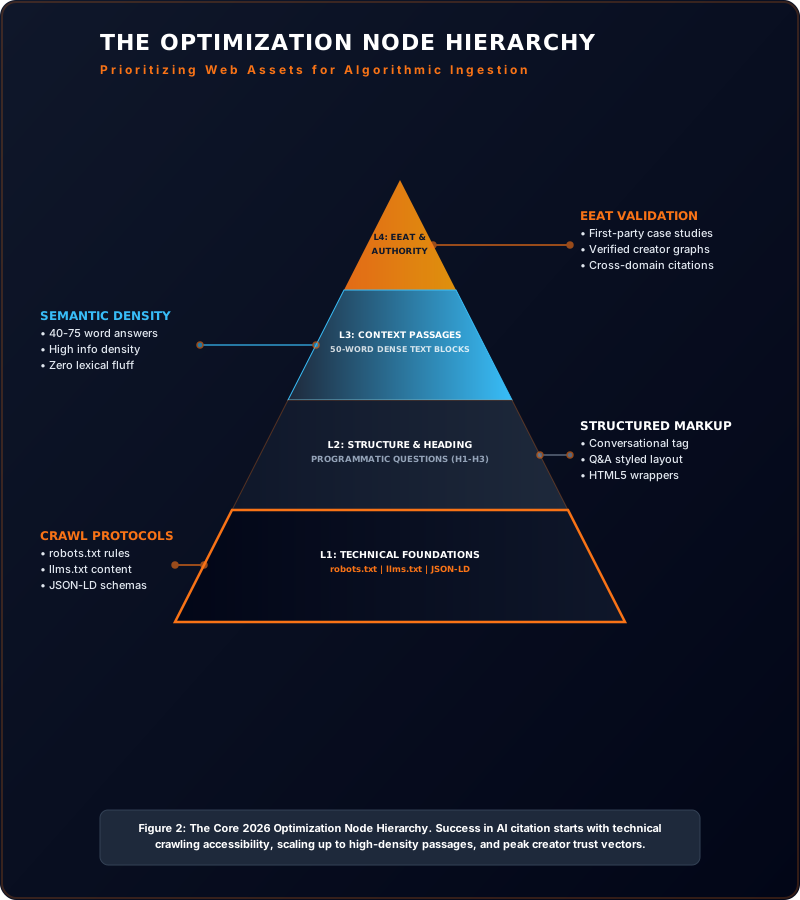
AI retrieval algorithms prioritize clear, concise, declarative statements when pulling answers for conversational queries. Every primary topic section within your digital ecosystem must begin with a 40-to-75-word answer block written exclusively in the indicative mood. Avoid introductory fluff, conditional phrasing, and empty transitions.
This is the essence of the 50-Word Direct Answer Rule. Structured correctly, answer engines retrieve these segments as single-point references.
Optimizing for Answer Engine Optimization requires aligning with the specific syntactic parser layouts used by prominent platforms. Specifically, conversational assistants like Apple Siri, Amazon Alexa, and Google Assistant, as well as conversational web platforms like Perplexity and Google AI Overviews, rely on rapid extraction algorithms that evaluate subject-predicate-object tuples. If your content is structured as speculative narrative, these systems cannot confidently map your page to the answer tree. Therefore, writing in the indicative mood and presenting direct, factual answers is a structural prerequisite for ranking on these conversational platforms.
Pillar 2: Generative Engine Optimization (GEO)
Generative Engine Optimization is the technical process of structuring web content so that Large Language Models (LLMs) can easily extract, chunk, and attribute your domain within synthesized responses.
LLMs do not evaluate full web pages; they analyze individual data chunks (passages). To score high on model ranking matrices, your content must possess extreme information density. This is achieved by injecting verifiable statistics, multi-column comparative data, clear percentages, and deep technical terminology directly into the text.
To succeed at GEO, content creators must optimize for the mathematical retrieval systems used by OpenAI SearchGPT, Gemini, and Claude. Rather than relying on simple sentence structure, these engines calculate a "factuality score" based on the presence of entity clusters and logical relationship trees. Content must feature semantic density, meaning that every passage should pack verified metrics, industry-specific taxonomy, and structured comparisons. For instance, rather than stating a product is "fast and efficient," specify the precise processing latency, throughput metrics, and comparative data tables. These elements form clear, high-density data nodes that models can easily index and display as verified facts.
How AEO and GEO Converge in Practice
While AEO and GEO target different retrieval architectures, they share a common foundational requirement: structurally precise, semantically dense content. In practice, the most effective enterprise content strategies deploy both methodologies simultaneously. A single web page can be optimized for AEO by opening each section with a 50-word declarative answer block, while the surrounding paragraphs are GEO-optimized with verifiable statistics, entity-rich taxonomy, and structured data matrices. This dual-layer approach ensures that the page is eligible for both zero-click answer panels and deep LLM citation retrieval.
Consider a practical example. A B2B SaaS company publishing a product comparison page would structure each feature heading as a natural language query (AEO), immediately followed by a concise factual answer. Below that answer, the page would embed a multi-column comparison table with precise latency benchmarks, uptime SLAs, and pricing tiers (GEO). The declarative heading captures voice search and featured snippet positions, while the data-rich table feeds directly into LLM synthesis pipelines. This convergence is not optional in 2026 — it is the baseline requirement for any domain that intends to maintain algorithmic visibility across both traditional and generative search channels.
Enterprise teams that treat AEO and GEO as separate workstreams risk creating content silos that underperform across both channels. The recommended approach is to build a unified content template that enforces both methodologies at the page level: every document begins with a structured answer block, followed by entity-tagged narrative paragraphs, supported by at least one structured data element (table, list, or schema markup). This template-driven workflow ensures consistency at scale and maximizes the probability of citation across Google AI Overviews, Perplexity, ChatGPT, and Claude simultaneously.
The Core 2026 Operational Optimization Matrix
This benchmark matrix defines the structural and strategic differences between historical web positioning frameworks and current machine-synthesis standards.
| Optimization Layer | Traditional SEO Framework | Modern AEO & GEO Architecture |
|---|---|---|
| Heading Structure | Phrase-based, keyword-stuffed strings (e.g., "Best ERP Software 2024"). | Explicit, conversational natural language queries (e.g., "How do enterprise ERP systems reduce cloud latency?"). |
| Formatting Unit | Long, narrative, text-heavy paragraphs designed to extend page dwell time. | 50-word modular direct-answer panels supported by distinct 50-word thematic text chunks. |
| Primary KPI | Organic search visibility, keyword ranking placement, and raw session clicks. | Document citation share, AI assistant recommendations, and direct conversational referral volume. |
| Trust Vector | Raw link volume, domain authority ratings, and anchor text matching profiles. | Verified Entity Graph positioning, comprehensive JSON-LD schema layers, and proprietary data nodes. |
| Data Layout | Inline narrative text descriptions of facts and statistics. | Explicit Markdown tables, visual infographics, structured lists, and high-density data matrices. |
Practical Application of the Matrix: Transitioning from SEO to AEO/GEO
Transitioning an enterprise content library from traditional SEO to a machine-optimized AEO/GEO format requires a systematic overhaul of both frontend markup and backend data feeds. The first operational step is to map existing high-performing pages against the primary entity graph. Rather than creating disjointed blog posts targeting broad keywords, content must be structured around core entity nodes (e.g., specific technologies, methodologies, or products) with clear, schema-defined relationships. Enterprise teams must audit their content for token density, purging lexical filler and replacing it with structured comparative lists and high-density data matrices.
Secondly, marketing KPIs must transition away from traditional SERP tracking. Success in 2026 is measured by your brand's citation share inside LLM syntheses, also known as "Share of Model Voice" (SoMV). This is verified by tracking how often your domain is cited for high-intent queries, what percentage of synthesized answers recommend your brand as the primary option, and the volume of referral traffic coming from conversational AI referrers. By explicitly defining entity relationships via JSON-LD and structuring textual segments in extraction-friendly blocks, brands can ensure their digital assets remain highly discoverable in the era of machine intelligence.
Implementation Priorities and the 90-Day Transition Timeline
Migrating an enterprise content portfolio from traditional SEO to a full AEO/GEO architecture is best executed in a phased 90-day sprint cycle. During the first 30 days, the priority is a complete structural audit: identify all high-traffic pages, evaluate their heading hierarchy against natural language query patterns, and deploy JSON-LD schema markup across the top 20 revenue-generating URLs. This foundational phase establishes the crawl and entity layer that both answer engines and LLM scrapers require before they can index your domain for citation retrieval.
In the second phase (days 31–60), content teams should focus on information density injections. Every audited page receives a 50-word direct answer block beneath its primary heading, all inline statistics are converted to structured HTML tables, and filler phrases are systematically purged. During this phase, teams should also deploy an llms.txt file at the domain root to explicitly declare tokenization permissions and preferred citation formats. This signals to AI crawlers that your domain is optimized for programmatic extraction, which accelerates indexing across platforms like Perplexity, Google AI Overviews, and OpenAI Search.
The final 30 days (days 61–90) focus on authority validation and measurement infrastructure. Creator profiles are linked to verified external nodes (LinkedIn, Google Scholar, corporate directories), proprietary case studies are published with first-party data, and monitoring dashboards are configured to track Share of Model Voice metrics. By the end of this 90-day cycle, the enterprise should have a fully operational AEO/GEO content pipeline — one that continuously publishes machine-optimized assets and measures their citation performance across all major AI synthesis platforms.
Common Migration Pitfalls and How to Avoid Them
The most frequent failure mode during SEO-to-AEO/GEO transitions is treating the migration as a one-time project rather than an ongoing operational discipline. Teams that restructure their top pages but fail to update their editorial workflow will see initial citation gains erode within 60–90 days as competitors adopt the same frameworks. To prevent this, organizations must embed AEO/GEO checkpoints directly into their content management system (CMS) publishing workflows — enforcing mandatory answer blocks, schema validation, and information density scoring before any new page goes live. Additionally, many teams underestimate the importance of maintaining consistent entity naming conventions across their entire digital ecosystem. If your brand, product names, or technical terminology vary across pages, AI models cannot confidently cluster your content into a unified entity graph, reducing your citation probability significantly.
Another critical pitfall is neglecting multi-platform verification. A page that earns citations in Google AI Overviews may be completely invisible to Perplexity or ChatGPT due to differences in their crawl schedules, tokenization methods, and factuality scoring algorithms. Enterprise teams must test their optimized pages across all major AI synthesis platforms — including Google AI Overviews, Perplexity Pro, ChatGPT with browsing, Claude with web access, and Microsoft Copilot — to ensure broad citation coverage. Dedicated monitoring tools such as Otterly.AI, Profound, and manual query-tracking spreadsheets should be deployed to create a unified citation dashboard. This cross-platform visibility audit should be conducted monthly, with results feeding back into the content optimization cycle to close any platform-specific gaps in coverage.
The Step-by-Step AEO & GEO Action Checklist
Use this definitive checklist to audit existing marketing collateral, technical documentation, and web pages before publication. Tap items to mark them complete.
Frequently Asked Questions
How do companies measure traffic and brand visibility inside AI answer engines?
To track brand placement across conversational search channels, enterprise teams must use manual tracking matrices for target queries paired with advanced tracking platforms like Otterly.AI. Success is confirmed when your domain appears inside text-based citations within a 30-day monitoring window, alongside clear spikes in direct referral traffic from conversational domains (e.g., chatgpt.com, perplexity.ai) inside your analytics platforms.
Does modifying a website for GEO degrade its traditional organic search rankings?
No, executing a modern GEO strategy does not jeopardize traditional organic search rankings. The core algorithms powering traditional SERPs and generative AI engines evaluate the same primary metrics: structural precision, high factual density, rapid technical rendering speeds, and verified entity authority. Optimizing content for machine retrieval naturally produces premium resources that score high across all indexing architectures.
Get the PDF version of this checklist for reference or printing.